


Algeria’s UNESCO World Heritage Sites
Algeria has seven sites inscribed on UNESCO’s World Heritage list, all of which can be visited on tours operated by Expert Algeria: Djemila ("one of the world’s great historical sights" according to the Lonely Planet), the M’Zab Valley, the Tassili, Timgad, Tipasa, the casbah of Algiers and Beni Hammad.Expert Algeria plans, designs, executes and accompanies guided tours to all Algeria’s UNESCO destinations, ranging from three-day trips to Ghardaia to three-week treks through the virgin desert of the Sahara.
UNESCO: Ghardaia
 Ghardaia is one of the pentapolis towns of the Saharan M’Zab Valley,
one of Algeria’s UNESCO World Heritage sites. In the walled settlement of Beni Isguen – normally closed to foreigners – the local
women, clad entirely in white,
reveal only one eye to the outside world.
Ghardaia is one of the pentapolis towns of the Saharan M’Zab Valley,
one of Algeria’s UNESCO World Heritage sites. In the walled settlement of Beni Isguen – normally closed to foreigners – the local
women, clad entirely in white,
reveal only one eye to the outside world.
UNESCO: Djemila
 Djemila
– ancient Cuicul –
is one of North Africa’s most monumental sites. Founded by Nerva,
the wheel-rutted streets of this garrison time are lined with two fora and a clutch of elaborate houses, churches and temples. Equally impressive is Djemila’s stunning museum of mosaics.
Djemila
– ancient Cuicul –
is one of North Africa’s most monumental sites. Founded by Nerva,
the wheel-rutted streets of this garrison time are lined with two fora and a clutch of elaborate houses, churches and temples. Equally impressive is Djemila’s stunning museum of mosaics.
UNESCO: Tipasa
 Tipasa, nestling undisturbed amongst palm trees on the shores of the Mediterranean, once served as an inspiration to Albert Camus.
Phoenician, Roman and Byzantine ruins vie for attention alongside the nearby
Mauritanian mausoleum.
Tipasa, nestling undisturbed amongst palm trees on the shores of the Mediterranean, once served as an inspiration to Albert Camus.
Phoenician, Roman and Byzantine ruins vie for attention alongside the nearby
Mauritanian mausoleum.
UNESCO: Timgad
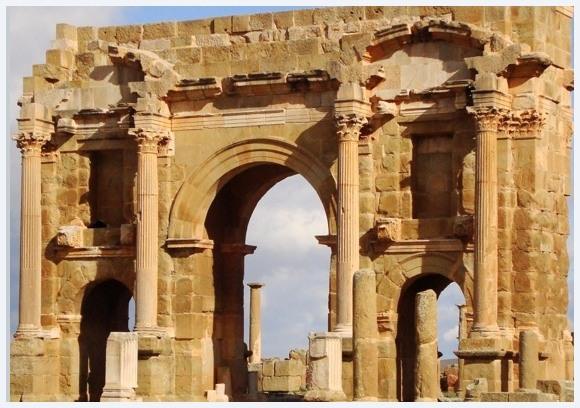
 Timgad, the “Pompeii of Africa”, was constructed under Trajan as a bulwark against the unruly Berbers.
With its immense library, colonnaded streets, myriad temples and imposing arch of Trajan, Timgad embodies Roman urban planning.
Timgad, the “Pompeii of Africa”, was constructed under Trajan as a bulwark against the unruly Berbers.
With its immense library, colonnaded streets, myriad temples and imposing arch of Trajan, Timgad embodies Roman urban planning.
UNESCO: Djanet and Tassili
 Algeria’s mountainous
Tassili region, bordering Niger to the south, is distinguished by its towering dunes of sand, its sheer-sided canyons, its beguiling “forests of rock” and over 15,000 rock carvings and
paintings.
Algeria’s mountainous
Tassili region, bordering Niger to the south, is distinguished by its towering dunes of sand, its sheer-sided canyons, its beguiling “forests of rock” and over 15,000 rock carvings and
paintings.
UNESCO: Algiers Casbah
 The
casbah of Algiers remains one of the world’s most mythical labyrinths:
“a masterpiece of architecture and town planning” according to Le Corbusier, the
Kasbah’s huddled houses tumble down the hill before seemingly spilling over into the sea.
The
casbah of Algiers remains one of the world’s most mythical labyrinths:
“a masterpiece of architecture and town planning” according to Le Corbusier, the
Kasbah’s huddled houses tumble down the hill before seemingly spilling over into the sea.
UNESCO: Beni Hammad
 Situated in a mountainous site of extraordinary beauty, the ruins of the
first capital of the Hammadid emirs, founded in 1007 and demolished in
1152, provide an authentic picture of a fortified Muslim city crowned by one of North Africa’s largest mosques.
Situated in a mountainous site of extraordinary beauty, the ruins of the
first capital of the Hammadid emirs, founded in 1007 and demolished in
1152, provide an authentic picture of a fortified Muslim city crowned by one of North Africa’s largest mosques.